My LinkedIn news feed has filled up with "IRR is fake" (thanks to following folks like constant PE-skeptic Ludo Phalippou). Some recent highlights:
- Yale claimed a suspiciously high 31%+ IRR since inception for its private equity allocation from 1972-2002.
- Another LinkedIn post that what matters is DPI, not IRR
Now: me thinking through this for myself ...
The math behind IRR
Ludo Phalippou kindly provides an online spreadsheet showing how the a long-term IRR can be virtually meaningless. His hypothetical example (Table 2 in the spreadsheet; I backfilled the unbolded IRRs) shows incredibly that the IRR stays virtually constant after 1999, regardless of positive or negative cash flows:

After seeing this the first time, I didn't believe it -- I figured the math was wrong, or the equations were wrong. Big cash flows up or down don't move the IRR. The reason is in the equation itself:
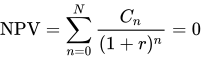
Given a long enough time frame (i.e. large n), each additional year's cash flow approaches 0. Extending Ludo's math, we can calculate how much each cash flow term contributes if you use IRR = 36.3%:

Why the distinction between IRR and DPI matter now
- Liquidity (i.e. VC/PE exits) have slowed down, meaning money is locked up longer in illiquid investments
- "You can't eat IRR" -- universities have gotten more cash-needy with Trump's war on higher-level education (including federal research funding cuts and increased excise tax), pushing top universities to budget cuts, hiring freezes, and secondary sales of private equities
A simple example
The textbook case for IRR goes something like: we invest $100 in year 1 in a new facility, which generates $55 in year 2 and $60 in year 3. The IRR here is straightforwardly calculated -- 9.7% -- and can be compared against other projects (e.g. investing in a different facility, or just investing the cash into a high-yield savings account). This use for IRR seems widely accepted: at a 9.7% return, the NPV of the cash flows is $0.

IRR does poorly with large IRR values
Take a simple fund: $100 investment in year 1, with $150 and $50 payouts in years 2 and 3:

This IRR feels high -- and when we go back to check, if we invested $100 in year 1 and got a 78% return for 2 years, we'd end up with $317 (or $117 more than the $200 we get in the above example!) What gives? IRR assumes you can re-invest the $150 cash flow from year 2 at a 78% return for 1 year -- which would be very, very difficult to do.
When the IRR is closer to the cost of capital -- say, 9.7% from the above example -- this issue gets swept under the rug, and "IRR" is a reasonable proxy for "return". But when the IRR is astronomical -- say, 78% or even 31% for Yale's PE portfolio -- IRR becomes detached from return, and thus can be misleading.
See: the Yale example above.
My 2 cents
There seem to be 2 big things in private equity valuations: (1) NAV valuations and (2) exits (i.e. distributions for the LP). Perhaps NAV and distributions should be measured separately, so each fund has (at least) 2 metrics. NAV (reported in annual growth) can help give an idea of how well the portfolio is progressing, based on how other VCs value the start-ups. Distributions (measured by DPI, or maybe even IRR) would be a separate metric.
A hypothetical example of what a cash-flow-only IRR might look like:

An expert re-weighs in
I wanted to check what the CFA Institute had to say about IRR corrections (e.g. MIRR in Excel) and once again ran into Ludo Phalippou. I also checked out the GIPS standards.
The takeaways from the resources:
- "IRR should not be misconstrued as equivalent to a rate of return."
- The IRR formula is simple, so it (a) hides assumptions like reinvestment rate and (b) can break down if the number of years gets too long
- Ludo suggests using a NAV-to-NAV IRR
- GIPS suggests using a time-weighted return (TWR) for evergreen funds
Perhaps next up in my meanderings: the private equity measurement alternatives (like PME/ KS-PME).


No comments:
Post a Comment